Deciding on HVAC repair vs replacement Fillmore involves comparing the unit's age and repair cost to the price of a full upgrade. Most homeowners should consider a replacement if the repair exceeds 25 percent of a new system's cost or if the unit's age multiplied by the repair estimate is over 5,000. This calculation ensures you invest in the most cost-effective and energy-efficient solution for your home comfort.
Living in Fillmore means relying heavily on your HVAC system to handle everything from high desert heat to biting winter winds. When your unit starts making strange noises or fails to keep your home comfortable, you are immediately faced with a stressful financial crossroad. Should you invest in a repair to get things moving again, or is it finally time to commit to a full replacement? At Gobes HVAC, we understand that this decision impacts both your immediate comfort and your long-term household budget. In this guide, we provide the expert clarity you need to navigate this dilemma. We will explore the industry standard $5,000 rule, the significance of the 15 year age benchmark, and the specific red flags that signal an urgent need for a new system. Our goal is to provide a practical roadmap for making the most cost-effective choice for your Utah home.
The Fillmore HVAC Dilemma: To Fix or to Replace?
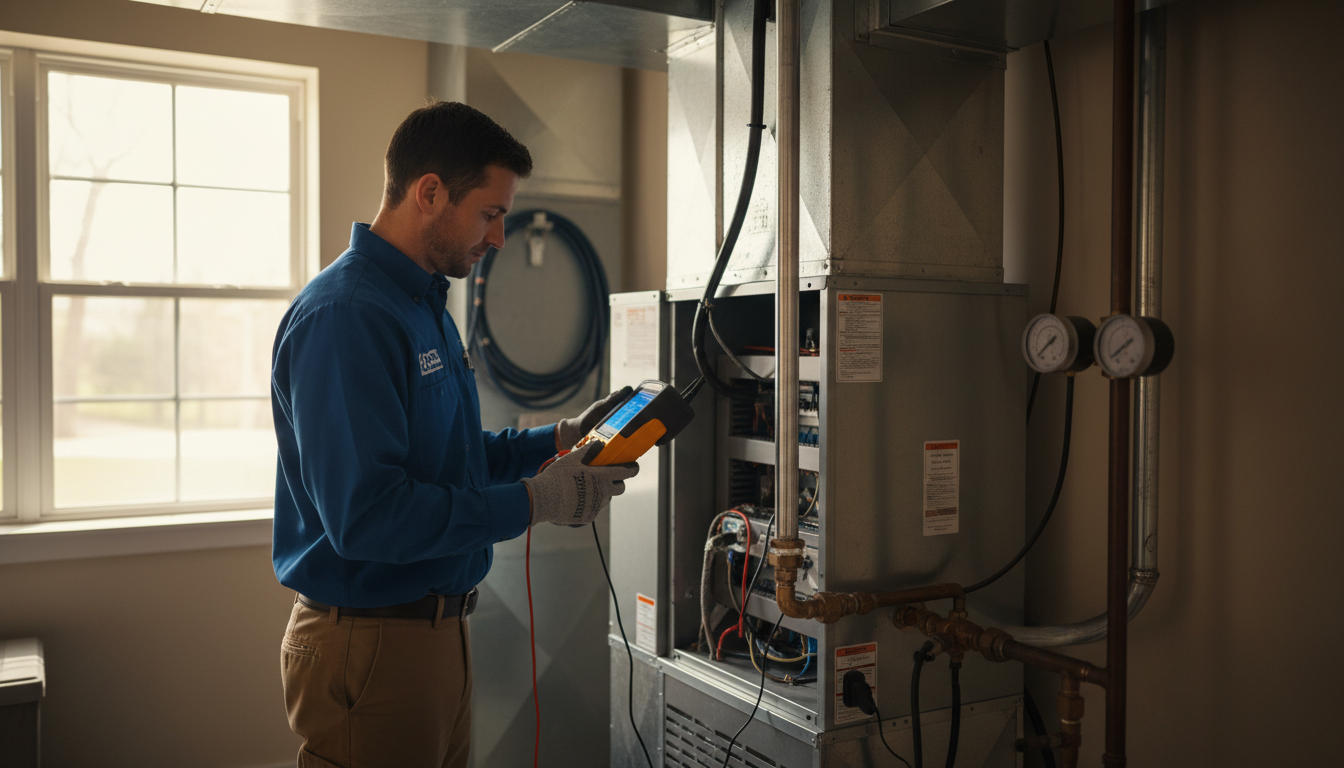
Homeowners in Fillmore understand that local weather is rarely moderate. Between the blistering heat of a Millard County summer and the sub-zero temperatures of a mid-January night, your heating and cooling system works under immense pressure. When a unit begins to rattle or fails to maintain the thermostat setting, the immediate question is always about the HVAC repair vs replacement Fillmore residents must navigate during a breakdown.
While your first instinct might be to schedule a quick fix to restore comfort, a simple repair is not always the most fiscally responsible path. Older units in our high-desert climate often experience accelerated wear on critical components like compressors and blower motors. At Gobes HVAC, we focus on providing honest diagnostics using modern tools to determine if a component failure is an isolated incident or a symptom of systemic decline.
Relying on an experienced HVAC team helps you look beyond the immediate bill. We evaluate the long-term reliability of your equipment against the cost of parts and labor. In Fillmore, where environmental extremes put extra strain on every mechanical part, making the wrong choice can lead to a cycle of expensive, recurring service calls during the peak of the season.
Understanding the $5,000 Rule for HVAC Systems
Determining the exact tipping point for a replacement can feel subjective, but the industry often relies on a mathematical benchmark known as the $5,000 Rule. This formula provides a clear financial threshold for homeowners. To apply it, multiply the age of your HVAC unit in years by the estimated cost of the current repair. If the resulting number is greater than 5,000, the investment in a repair is likely a poor use of funds compared to the long term value of a new system.
For example, consider an air conditioning unit that is 12 years old and requires a $500 blower motor replacement. Using the formula (12 years x $500 repair cost), the total is 6,000. Because 6,000 exceeds the $5,000 benchmark, replacing the unit is generally the smarter financial decision. Conversely, if a 5 year old furnace needs the same $500 repair, the total is only 2,500, suggesting that reliable heating and cooling services are still a sound investment for that equipment.
Age of Unit (Years) | Repair Cost ($) | Calculation (Age x Repair) | Recommended Action |
|---|---|---|---|
5 | $400 | 2,000 | Repair |
8 | $600 | 4,800 | Repair / Evaluate |
12 | $500 | 6,000 | Replace |
15 | $400 | 6,000 | Replace |
This rule helps remove the emotional stress from the HVAC repair vs replacement Fillmore residents must navigate. While it is not a rigid law, it highlights how the diminishing returns of aging equipment affect your monthly budget. When a system reaches a certain age, small repairs cannot offset the inherent inefficiency and the high risk of secondary component failures common in our high desert climate. Using this math allows you to make a data driven choice rather than a reactive one during a service call.
When HVAC Repair is the Smart Choice
While the mathematical benchmarks provide a helpful boundary, several practical scenarios exist where opting for a fix is the objectively better investment. If your system is under ten years old, it is often still in the prime of its operational life. Many Fillmore homes have systems still covered by manufacturer parts warranties, which can significantly offset the cost of a fix. Replacing a common component like a dual run capacitor, a contactor, or a fan motor is standard maintenance for a mid-life system and does not indicate the end of its lifespan.
A single mechanical failure rarely means the entire unit is compromised. If you have stayed consistent with reliable heating and cooling services from a professional like Gobes HVAC, your equipment is likely in good internal condition. Regular cleaning and seasonal inspections prevent the kind of systemic strain that leads to early retirement. In these cases, the HVAC repair vs replacement Fillmore homeowners evaluate becomes a simple matter of restoring the existing system’s efficiency. Choosing to repair a well-maintained, younger unit allows you to maximize your initial investment while deferring the significant capital expense of a new installation. As long as core components like the compressor or heat exchanger remain healthy, a targeted repair is the most practical path forward.
The 10 to 15 Year Benchmark: Age Matters
ENERGY STAR guidelines provide a standard baseline for system longevity, suggesting that homeowners consider replacement for air conditioners after 10 years and furnaces after 15. In Fillmore, our harsh, high desert summers often accelerate this timeline. Air conditioning units typically provide peak performance for about 10 to 12 years before internal wear significantly degrades efficiency. Conversely, a furnace receiving reliable heating and cooling services might push toward the 15 or 20 year mark.
Industry shifts also introduce a form of planned obsolescence through refrigerant phase outs. Older systems often rely on R-22 Freon, which is no longer manufactured due to environmental regulations. This makes recharging an older unit with even a small leak prohibitively expensive. As these older refrigerants become scarce, the HVAC repair vs replacement Fillmore decision is often dictated by the lack of affordable supplies. Transitioning to a modern system ensures your home uses current, readily available refrigerants while eliminating the risk of being stranded by obsolete technology.
Three Red Flags That Mean Replacement is Urgent
Beyond the age of the unit, certain deal breakers indicate that a system has reached the end of its safe or functional life. The most critical red flag involves safety hazards, specifically a cracked heat exchanger in your furnace. The heat exchanger is responsible for separating combustion gases from the air circulating through your home. If it cracks, carbon monoxide can leak into your living space. Because this poses a direct threat to your family, a cracked heat exchanger is rarely worth a repair; the labor and part costs often rival the price of a new, safer unit.
A second warning sign is the nickeled and dimed effect. If you find yourself scheduling service calls every season, the cumulative cost of these minor fixes quickly outweighs the value of the equipment. Frequent failures suggest that the system’s internal components have reached a point of systemic fatigue. When a unit requires back to back repairs to survive a Fillmore summer, it is a signal that a total breakdown is imminent. Paying for three small repairs in two years is often more expensive than the monthly financing on a reliable new system.
Finally, keep a close eye on your Millard County utility bills. As HVAC systems age, they lose their ability to transfer heat efficiently. This causes the motor and compressor to run for significantly longer cycles just to reach the temperature set on your thermostat. If your energy costs are skyrocketing despite normal usage, your current equipment is likely hemorrhaging money. Investing in a modern, high efficiency unit through reliable heating and cooling services can dramatically reduce these monthly expenses while providing more consistent comfort. These red flags help clarify the HVAC repair vs replacement Fillmore choice by highlighting when a system is no longer just old, but actively detrimental to your home budget and safety.
The Hidden Costs of Keeping an Old HVAC System
Maintaining an aging unit often leads to the sunk cost trap. Homeowners in Fillmore might feel that spending $600 on a repair protects their initial investment, but in reality, that money is being poured into a depreciating asset with declining performance. Unlike a repair, which only restores the status quo, a new installation provides a measurable return on investment through lower monthly overhead.
Modern SEER2 rated equipment operates with precision that older models cannot match. By switching to a high efficiency system, you can often see a reduction in energy consumption of 20% to 40%. These savings, compounded over the next decade, can offset a significant portion of the installation price. Additionally, federal tax credits and local utility rebates for high efficiency upgrades further lower the financial barrier, making it easier to transition to a more reliable system.
When weighing the HVAC repair vs replacement Fillmore choice, look beyond the immediate invoice. An old system costs more in ghost expenses; higher bills, frequent reliable heating and cooling services calls, and the constant threat of a mid-season breakdown. Investing in new technology transforms an unpredictable expense into a predictable, long term asset that enhances both home value and daily comfort.
How Gobes HVAC Helps Fillmore Residents Decide
Navigating the HVAC repair vs replacement Fillmore decision is easier when you have a local partner who understands our specific environment. At Gobes HVAC, we do not rely on guesswork or high pressure sales tactics. Our experienced HVAC team utilizes modern diagnostic tools, including digital manifold gauges and combustion analyzers, to generate an accurate health report for your equipment. This report identifies specific points of failure and measures your system's current efficiency against original manufacturer specifications.
Because we live and work in Fillmore, we understand how the high desert climate and seasonal temperature swings impact the local housing stock. We know the common ductwork challenges in older Millard County homes and the specific load requirements for newer builds. This local perspective allows us to provide recommendations tailored to your home's unique footprint and your family's comfort needs.
Every repair or installation we perform is strictly code compliant, ensuring your system operates safely and according to modern standards. We prioritize solutions that maximize energy efficiency and long term reliability rather than offering temporary patches. To get a professional, transparent evaluation of your system's current condition, contact Gobes HVAC today. Our focus remains on providing reliable heating and cooling services that help you make the most informed choice for your home and your budget.
Deciding whether to repair or replace your HVAC system depends on its age, efficiency, and frequency of breakdowns. While some issues only require a quick fix, others signal that a new unit is a better investment for future comfort. If you are still unsure which path is right for your home, our team is here to guide you. You can read more about our commitment to the Fillmore community, and we are happy to provide an honest assessment so you can make an informed decision for your family.